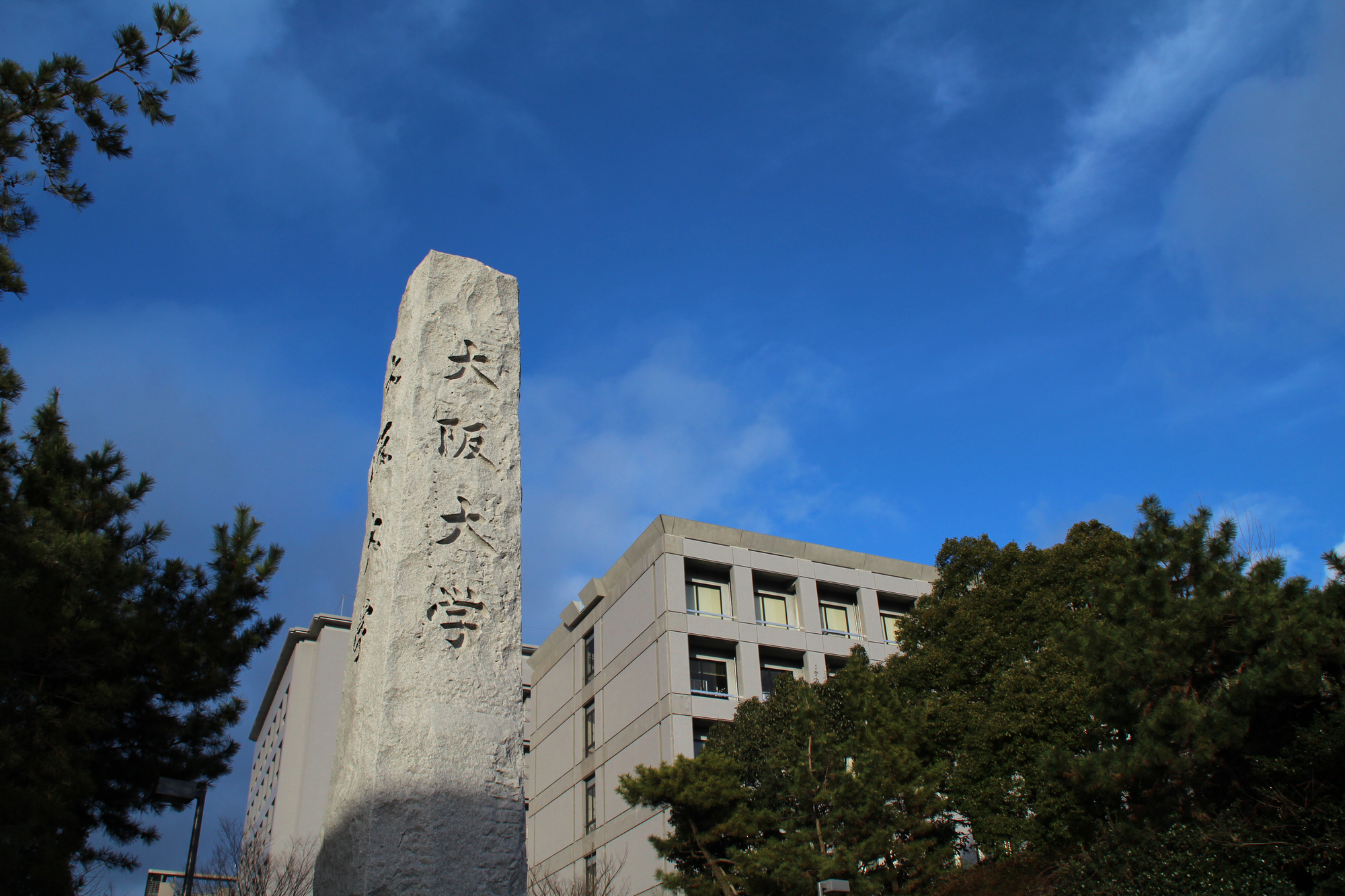
Last fall, Professor Kobe Tetsuya was awarded the Special Prize at the 14th "Frontier Salon Nagase Award"* for his research and development into "Manipulating Atoms to Create Inorganic Quantum Materials." He has been attracting attention as a young leader in the development of quantum materials, materials necessary for next-generation cutting-edge technologies such as quantum computers and superconductors. This time, he focused on an inorganic substance called "borophene," pioneering a new substance that can be used as a material and developing it into a liquid crystal material, which was recognized as opening the door to a new field of materials science. We spoke to the professor about his journey so far, the secret story behind his success, and his dreams for the future.
*The Nobel Prize is awarded to young researchers who are engaged in world-leading research that will contribute to the future of humanity, with the aim of discovering "future Nobel Prize candidates."
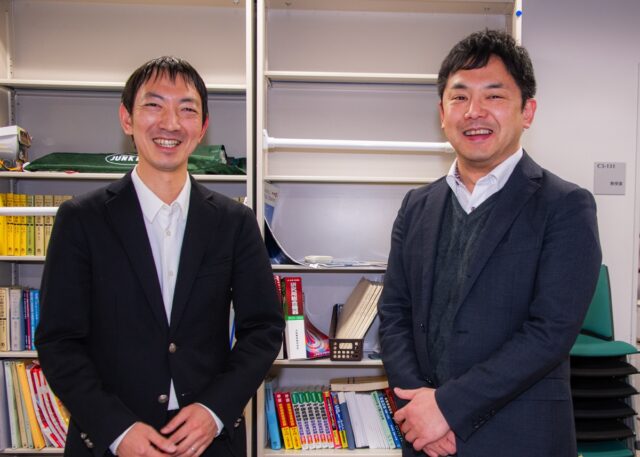 With Professor Shigeyuki Masaoka, head of the laboratory. Professor Masaoka specializes in basic research into artificial photosynthesis. Under his supervision, about 20 graduate and undergraduate students work hard on research in a friendly atmosphere.
My career as a researcher
Intuition leads me to the path of chemistry
"It all started when my teacher asked me, 'Why don't you try out for the International Chemistry Olympiad?' when I was in my first year of high school. I'd always loved physics and mathematics, but chemistry wasn't my forte. However, I thought it was a rare opportunity, so I decided to give it a try. In my first year, I was defeated miserably in the national qualifying Chemistry Grand Prix. But this made me feel frustrated, so the following year, when I was in my second year of high school, I studied hard and somehow managed to place highly in the national qualifying round and was chosen to represent Japan. I then competed in the International Chemistry Olympiad and won a bronze medal. The problems in the Chemistry Olympiad cannot be solved by simple memorization; you need the ability to think things through logically. It was here that I realized how fascinating it was to think," says Kobe, looking back on his high school days.
He then went on to the University of Tokyo. "The University of Tokyo has a unique system called the 'advancement system,' which allows students to decide their department from their third year onwards based on their grades in their first and second years. I was really torn between going on to physics or mathematics, or choosing chemistry, but in the end my desire to 'pursue the subject I found most interesting' won out, and I chose chemistry," says Professor Kobe.
After completing his doctoral studies, Professor Kobe got jobs at Tokyo Institute of Technology and other institutions before moving on to Osaka University, where he began to focus on developing new inorganic materials, mainly borophene.
A chance discovery? The world's first inorganic liquid crystal
Borophene is a new material with a two-dimensional structure in which boron atoms are arranged in a single layer. The name corresponds to "graphene," a sheet-like material in which carbon atoms are arranged in a honeycomb pattern. Graphene, which is made of carbon atoms, is very light, strong, and has good electrical and thermal conductivity, making it a promising material for next-generation electronics. In 2010, Andre Geim and Konstantin Novoselov were awarded the Nobel Prize in Physics for peeling off a single layer of graphene from graphite using adhesive tape and revealing its properties.
Although borophene, which is made up of boron atoms, has a similar structure to graphene, different functions were expected due to the unique properties of boron. However, "the biggest challenge was that it reacts easily with oxygen and quickly oxidizes and decomposes, making it difficult to use stably," says Professor Kobe.
Professor Kobe's research team at the Tokyo Institute of Technology was trying to create a more stable "borophene oxide" by introducing oxygen atoms into each layer of borophene. One day, during an experiment conducted by chance by a student, an unfamiliar substance was produced that showed unique optical properties never seen before. "What on earth is this?" the team members were puzzled, but a researcher who happened to be there and is knowledgeable about liquid crystals lit up his eyes. "This is behaving like a liquid crystal!" This was the moment when a new inorganic liquid crystal was born.
"At first, I never thought it would become liquid crystal. But we had a liquid crystal specialist nearby who pointed out that this might be liquid crystal, and that's when our research developed in a new direction," recalls Professor Kobe.
Further improving electronic functionality by introducing borophene oxide and cations
Professor Kobe's team then discovered that introducing certain metal ions (cations) between the layers of borophene oxide results in the development of new properties. In particular, when alkali metal cations such as potassium (K), rubidium (Rb), and cesium (Cs) are introduced, the bonds between the layers are weakened and the liquid crystal properties become more clearly evident.
Electronic devices incorporating these materials have a dramatically improved capacitance (the ability to store an electric charge). In particular, potassium-doped borophene oxide liquid crystal (K-BoLC) exhibits a capacitance 10⁵ times higher than that of conventional materials when placed between electrodes.
*While the dielectric constant of current high dielectric materials is around several thousand, borophene oxide liquid crystal has the potential to far exceed that value.
Inorganic LCDs are so much more amazing than organic LCDs!
Until now, most liquid crystals have been made up of organic compounds. The newly developed inorganic liquid crystal has several major features that set it apart from other liquid crystals. These are summarized below.
1. High thermal stability
Conventional organic liquid crystals made of low molecular weight molecules tend to become isotropic liquids at high temperatures and cannot withstand high temperatures, but inorganic liquid crystals are thermally stable and can maintain their structure even in high temperature environments.
2. High durability and resistant to deterioration
Inorganic compounds are generally resistant to abrasion and ultraviolet light, so their use in displays and optical devices can significantly extend their lifespan.
3. Excellent device characteristics
Inorganic liquid crystals have the property of increasing capacitance much higher than that of conventional dielectrics, improving the energy storage capacity of electronic devices. This is thought to be due to the movement of cations in borophene oxide liquid crystals under the influence of an electric field.
4. Reducing environmental impact
Some organic liquid crystals use carbon-based chemicals during production, which are environmentally harmful, but since they do not use carbon, they have the potential to make for environmentally friendly devices.
Borophene, which has the above characteristics, is expected to have a variety of industrial applications. "One of them is that it is a liquid crystal that can be used in harsh environments such as space," says Professor Kobe. Conventional organic liquid crystals decompose and deteriorate in harsh environments, making them difficult to use in extreme environments such as artificial satellites and space telescopes. However, inorganic liquid crystals have high heat and radiation resistance, so they may be able to withstand strong radiation and extreme temperature changes.
"For example, isn't it exciting to think of applications such as optical instruments for artificial satellites or variable lenses for space telescopes?" Professor Kobe shared his big dreams for the future.
Message to high school students
The physics and chemistry subjects studied in high school are very important as a foundation, but what you use in the world of research is on a whole other level. I myself was able to get a glimpse of this by participating in the International Chemistry Olympiad, which was what led me to choose my current research field. Today's high school students have plenty of opportunities to come into contact with the latest research, such as university lectures, symposiums, and open campuses. I think that if you are not confined to the scope of what you learn at school, but have the enthusiasm to stretch yourself a little, you can peek into a very fun world.
Boron and carbon are next to each other
In the periodic table, carbon (C) and boron (B) are adjacent elements and have similar chemical properties. Just as "graphene," which is made of carbon, has extremely high electrical conductivity and strength, "borophene," which is made of boron, also exhibits unique electronic properties. As the periodic table shows, nearby elements often have similar properties, but are expected to exhibit new functionality.
What is a superatom?
Another of Professor Kobe's research subjects is "superatoms," special clusters of multiple atoms that behave like a single "new atom." Normally, the properties of an atom are determined by the number of protons and electrons it has, but by artificially designing the internal electronic structure of a superatom, it exhibits properties that are reminiscent of a new element.
For example, the Al₁₃ cluster, which consists of 13 aluminum atoms, is known to have properties similar to those of halogen elements (such as fluorine and chlorine). In addition, superatoms using main group elements such as gallium and bismuth have also been developed, and both are expected to be used as new catalysts and electronics materials.
"The periodic table is limited, but superatoms have the potential to create materials with new functions not found in the periodic table," says Professor Kobe. "Research into 'superatoms' has only just begun, but it is attracting a great deal of attention as a field with the potential to artificially expand the periodic table."

Associate Professor, Osaka University / Young Distinguished Faculty Member
Professor Tetsuya Kobe
Born in 1986 in Hyogo Prefecture. Completed his doctoral studies in chemistry at the University of Tokyo Graduate School of Science. PhD (Science). After working as a special researcher at the Japan Society for the Promotion of Science, he is now an assistant professor at the Tokyo Institute of Technology's Institute of Resource Science. He has worked as a special lecturer at Taiwan Chiao Tung University and an adjunct lecturer at Meiji University before assuming his current position. He also serves as an emergent researcher at the Japan Science and Technology Agency. In 2024, he received the Young Scientists' Award from the Minister of Education, Culture, Sports, Science and Technology. His specialties are inorganic chemistry, nanomaterials science, and metal complex chemistry. He is a graduate of Hakuling High School.