Juntendo University has long focused on medicine, nursing, and sports health science as its core areas of study. Over the past decade, it has successively established the Faculty of International Liberal Arts, the Faculty of Health Sciences, the Faculty of Medical Sciences, and the Faculty of Health Data Science. In 2024, it will open the Faculty of Pharmaceutical Sciences, solidifying its position as a "comprehensive health university" with nine faculties and six graduate schools. In recent years, its initiatives have expanded to a wide range of fields, including advanced medical care, community medicine, and geriatric medicine at its affiliated hospital, as well as support for pharmaceutical development, intellectual property work, clinical trials, the establishment of university-launched venture companies, regenerative medicine, nursing, and sports. We interviewed President Hiroyuki Shirota about the university's vision and human resource development policies.
What kind of medical care will be needed in the era of 100-year lifespans?
Responding to the needs of society, we strive to become a "Comprehensive Health University"
"Our university's roots date back to the Dutch medical school that was established in the Edo period. For nearly two centuries since its founding, we have provided holistic education that allows students to practice medicine, health, and welfare, centered on the three pillars of education, research, and clinical practice. In the last decade, we have opened five faculties and are in the process of establishing ourselves as a comprehensive health university, in response to the demands of the times and society."
In this age where people are expected to live to 100 years old, one of the challenges is how to achieve healthy longevity. To take on advanced and complex medical care - advanced medical treatment, emergency medical care, cancer treatment, elderly care, etc. - we need not only doctors and nurses, but also medical professionals with practical skills and specialists in data science who contribute to health science and preventive medicine. "To improve the quality of medical care, it is essential to train capable medical staff. We see this as the mission that has been assigned to us at Juntendo University."
Through the establishment of a series of faculties, the university is opening up a range of pathways to a variety of medical professions.
"When people think of medical universities, they tend to focus on doctors and nurses, but at our university, students can aim to become medical professionals such as pharmacists (Faculty of Pharmacy), physical therapists who handle rehabilitation, radiological technologists who handle radiation (Faculty of Health Sciences), clinical laboratory technologists who perform tests and analyses, and clinical engineers who operate dialysis machines and artificial heart-lung machines (Faculty of Medical Sciences). We want students to take advantage of being a comprehensive health university and learn about team-based medical care as well."
President Shirota continued, "It is also a tradition of our university that faculty members are close to students and look after them well. There is a room for faculty and students to meet near my lab, and it is always busy. Because the faculty members are so enthusiastic about their guidance, it has created an environment where students feel comfortable asking questions and are motivated to study." This is also reflected in the high pass rates for national exams for doctors, nurses, etc.
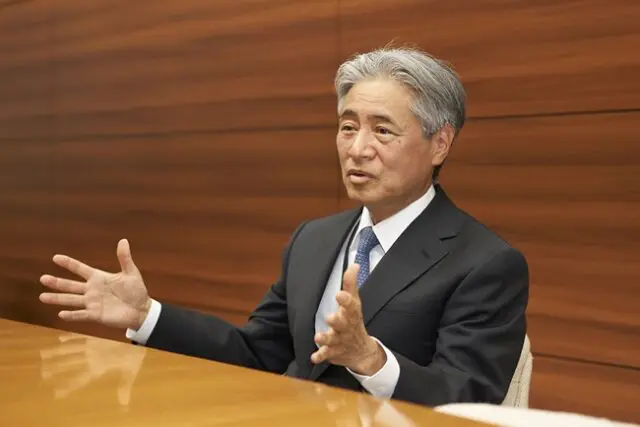 "There is a lot that needs to be done, such as collaboration between industry, government, academia and the public," says President Hiroyuki Shirota.
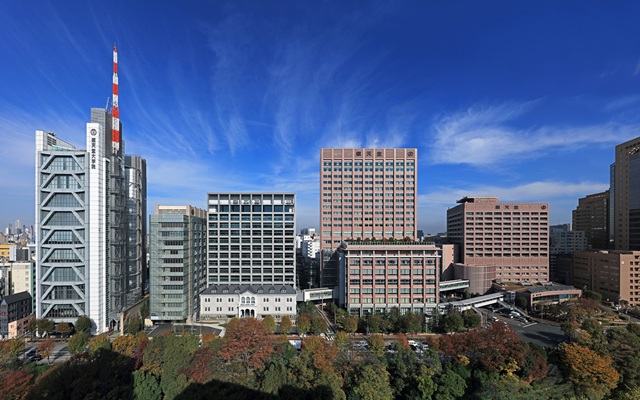
In April 2022, the Urayasu-Hinode Campus was established, bringing together the Faculty of Medical Sciences, the Faculty of Health Data Science, and the Faculty of Pharmaceutical Sciences.
Given the aging of Japanese society, advancements in medical technology, and the importance of team-based healthcare, Juntendo University has been at the forefront of reform, and in April 2022, it opened a new campus in Urayasu-Hinode.
The campus houses three faculties: the Faculty of Medical Sciences, the Faculty of Health Data Sciences, and the Faculty of Pharmaceutical Sciences. The Faculty of Medical Sciences provides specialized learning in testing, analysis, and engineering to support teams in medical settings, through the training of clinical laboratory technologists and clinical engineers. The Faculty of Health Data Sciences aims to produce "health data scientists," who will be the drivers of digital innovation in the health field, using accumulated data related to medicine, health, and sports. The Faculty of Pharmaceutical Sciences trains pharmacists with high clinical practice skills and drug discovery researchers with a clinical understanding. Students can learn about team medicine in collaboration with the Faculty of Medicine and the Faculty of Medical Nursing, as well as systematically study drug therapy.
The Urayasu-Hinode Campus offers an educational and research environment that connects and expands medical care with AI and data science in a way that other universities cannot replicate, aiming to become a sustainable, future-oriented campus.
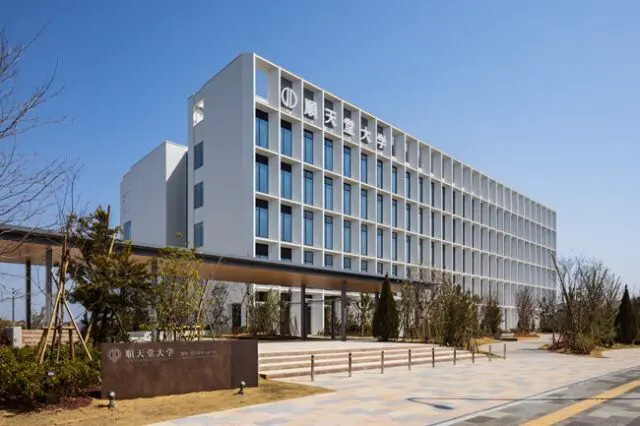 The Urayasu-Hinode Campus houses the Faculty of Medical Sciences, the Faculty of Health Data Science, and the Faculty of Pharmaceutical Sciences.
Driving globalization and data analysis
International Liberal Arts and Data Science
At the School of International Liberal Arts, students can receive a liberal arts education while acquiring an international perspective, based on a medical and health background. By honing their expertise in healthcare from a global perspective, they will be able to play an active role both at home and abroad. "By sending out talented people to work for international organizations such as the WHO, we hope that our university will become a driving force in globalization, demonstrating its international competitiveness and expansion capabilities."
Furthermore, this global-minded educational policy is applied to the entire university. The university has been working to improve its foreign language education and has supported students in studying abroad and taking short-term overseas training programs. The university also accepts many international students from overseas and promotes the internationalization of the university. All students in all faculties are required to take the TOEFL test in the spring and fall after enrollment, allowing them to regularly check their English proficiency.
With data science becoming a trend in university education, the Faculty of Health Data Science was opened in 2023. "In the future, support based on data science will be important to maintain the quality of medical care and research and development. We are now in an era where knowledge gained from mathematical statistics and the use of AI technology are indispensable."
For example, in the field of drug discovery, AI-based simulations are attracting attention as a new development method amid restrictions on animal testing. People who can handle AI and big data and are skilled in data analysis will be in demand not only in the fields of medicine, sports, and health science, but also in all other fields, including business.
Juntendo University is also looking to train specialists from data science and global perspectives. It will be interesting to see how the university develops in the future as a "comprehensive health university."
President of Juntendo University
Hiroyuki Shirota
Born in 1954
March 1979 Graduated from Juntendo University School of Medicine
April 1979, Toranomon Hospital, Department of Internal Medicine
April 1987: Assistant Professor, Department of Internal Medicine and Department of Cardiovascular Medicine, Juntendo University School of Medicine
November 1992: Obtained Ph.D. (Medicine) (Juntendo University)
August 1993: Visiting Physician and Scientist, Division of Cardiovascular Diseases, Mayo Clinic, USA
November 1995: Lecturer, Department of Internal Medicine and Department of Cardiovascular Medicine, Juntendo University School of Medicine
July 2000: Professor, Department of Internal Medicine and Department of Cardiovascular Medicine, Juntendo University School of Medicine
April 2014: Director of Juntendo University Hospital
April 2016: Dean of the Graduate School of Medicine and Faculty of Medicine, Juntendo University
April 2019: Dean, Faculty of Health Sciences, Juntendo University
April 2023: Dean, Graduate School of Health Sciences, Juntendo University
April 2024 President of Juntendo University