"Recognize people, don't exclude anyone, and build camaraderie"—Seisa University is a distance learning university that operates under these three principles. It has the only "Faculty of Coexistence Science" in Japan, offering a wide range of learning opportunities in fields such as education, welfare, environment, international relations, and sports and physical expression, and cultivating individuals who can contribute to the realization of a symbiotic society. In particular, Professor Toshihiko Abe's research theme of "universal design in education" is deeply connected to the philosophy of Seisa University, and educators from various fields are engaged in research in Professor Abe's seminar. We spoke with Professor Abe in detail about the role that universal design in education plays in the educational field and the significance of being involved in research at Seisa University.
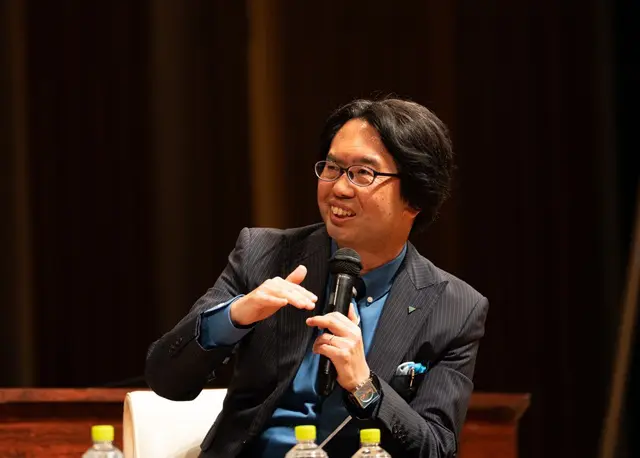 Professor Toshihiko Abe, Graduate School of Educational Practice, Seisa University
"Easy-to-understand lessons benefit all children"—An encounter with universal design in education
This happened about 20 years ago. Professor Abe, whose research focused on special needs education, encountered a certain research group. It was the "Learning Universal Design Research Group (now the Japan Learning Universal Design Society)," which was established with the aim of integrating subject education and special needs education.
Professor Abe was deeply impressed when he observed a surprise lesson at an elementary school conducted by Satoshi Katsura, then chairman of the Universal Design for Education Research Group (currently Chairman of the Japan Universal Design for Education Society and Associate Professor in the School Education Course at Kyoai Gakuen Maebashi International University). Despite it being the first lesson taught by this teacher, the children in the class were captivated by the lesson's progression, and every child was leaning forward with enthusiasm. This was a practice based on a well-thought-out teaching theory that could be applied to any subject, with the philosophy of creating a classroom where all children can learn safely and happily.
"In education, there's a concept called the 'RTI model,' which views educational support as a three-tiered pyramid. The foundational first-tier support is 'lesson planning and environment creation,' which is equivalent to universal design in education. However, simply building the foundation isn't enough to support all children. Therefore, we build upon that with second-tier support (individualized consideration) and third-tier support (individualized instruction)."
Professor Abe had previously believed that individualized support, which constitutes the second and third levels of support, was crucial in providing special needs education. However, his perspective changed after observing a class based on the principles of universal design.
"Based on the principles of Universal Design in the classroom (focusing, visualizing, and sharing), I realized that providing 'understandable, doable, and enjoyable lessons' for diverse children would be beneficial for both children with and without developmental disabilities. While individual considerations are certainly important, it is crucial to enhance the foundational primary support."
Professor Abe wanted to provide lessons that would allow more children to feel small joys and pleasures in their daily school life, so that they could say, "Today was fun." It was with this in mind that he began to seriously research universal design in education.
Three elements that constitute universal design in education
Professor Abe is currently affiliated with Seisa University, a distance learning university that is the only one in Japan to have a "Faculty of Symbiotic Sciences." Based on its educational philosophy of "contributing to the creation of a society in which people and people and nature coexist," the university provides an environment where people from diverse backgrounds can learn anytime, anywhere. In addition to supervising graduate students in seminars, Professor Abe also teaches several undergraduate courses.
"I believe that universal design in education consists of three elements: universal design of the classroom environment, universal design of the lesson, and universal design of the human environment. By connecting these three elements, we will create a safe and secure learning environment for children."
The easiest approach is "universal design for the classroom environment." For example, keeping the blackboard clean, clearly displaying the day's schedule, and carefully displaying children's artwork. "In a clean classroom environment where unnecessary stimuli are removed as much as possible, children can learn in a calmer atmosphere."
"Universal design in lessons" is based on the concepts of "focusing," which involves narrowing down the important perspectives that we want to convey to children; "visualization," which involves using visual materials to communicate; and "sharing," which involves sharing diverse opinions to deepen understanding. "Focusing, visualization, and sharing—these are the three pillars of UD in lessons advocated by Chairman Katsura, as mentioned earlier. We will review each subject based on these three pillars and check whether we are conveying what we want to tell the children."
"Universal design for the human environment" is a concept advocated by Professor Abe. It emphasizes not only providing easy-to-understand lessons, but also creating a safe space where children can express their opinions. The key is to strive to create a warm classroom environment where children feel, "It's okay to make mistakes, and it's okay to be different from others."
"Instead of saying, 'Listen to what others have to say,' I tell them, 'When you listen to what others have to say, everyone's treasures increase.' By teachers carefully accepting children's opinions and becoming role models for active listening, we can create an environment where children can respect each other. That is universal design in the human environment."
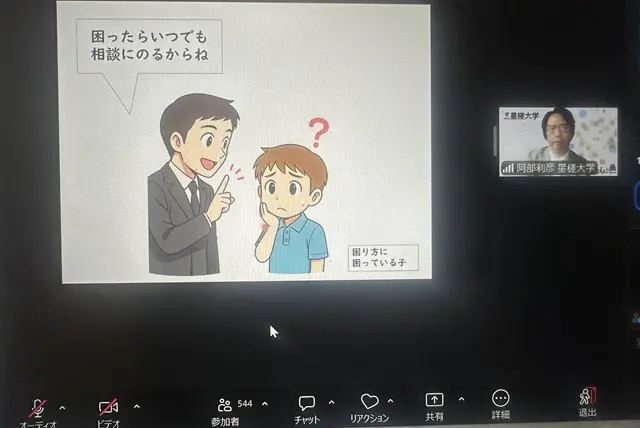 An online seminar was held featuring Professor Toshihiko Abe and alumni of his seminar. The topic was "What is important in fostering children's ability to seek help in school settings" (organized by the Child Development Support Research Group).
Educators who are constantly struggling in the field of education gather at Professor Abe's seminar.
While Seisa University certainly has young students who enroll after graduating from high school, a distinctive feature is the large number of people who enroll after entering the workforce and wanting to further their education. Professor Abe's seminar brings together a diverse group of people in teaching positions, including teachers from elementary, junior high, and high schools, as well as teachers working at training schools for healthcare professionals such as nurses and occupational therapists, and teachers from culinary schools.
"Universal design in education isn't something special; it's a way of thinking that reduces the number of people who get left behind or isolated in their learning. This isn't limited to elementary or middle school. The desire to 'make lessons easier to understand' is something that everyone in a teaching position shares."
The research topics are also diverse. A teacher at a culinary school studies "universal design of cooking techniques," while a teacher at a nursing school tries to incorporate the concept of universal design into "breastfeeding guidance for postpartum women." There is even a former kindergarten principal who, after graduating from the Faculty of Symbiotic Sciences at Seisa University, went on to graduate school to research "universal design of play."
"I'm not an expert in nursing or cooking, so I learn a lot from graduate students. Universal design in education is a new field of study, so there's a real excitement in pioneering it together with the students."
So, why did the students conducting research in Professor Abe's seminar decide to pursue graduate studies?
"What they all have in common is that 'doubt' and 'questions' are their motivation for pursuing further education. They often wonder, 'Is this lesson okay? Was my interaction with the students appropriate?' These are common feelings when working with children and students in educational settings. My seminar students have come to Seisa University Graduate School to research universal design in education in my seminar, seeking answers to these doubts and uncertainties."
However, Professor Abe asserts, "There is no single answer to what education should be." "The beauty of studying in graduate school lies in the fact that each student can share the doubts they have with their peers and become free from fixed ideas and biases that they had assumed were 'just the way things were.'"
In one class, Professor Abe interacted with a visually impaired student and developed the concept of universal design in education from "focusing, visualizing, and sharing" to "focusing, multi-sensory, and sharing." "Thanks to encountering universal design in education, I myself was freed from the bias of 'university classes are like this.'"
A university that encourages continuous thinking, not one that simply provides the correct answers—a unique learning experience at Seisa University.
Seisa University, a distance learning institution, offers a flexible learning system tailored to students' lifestyles. Because there is no set enrollment period, students can continue learning at their own pace. Therefore, some students take 10 years to graduate, while others interrupt their studies and then re-enroll.
"When I observe our students, I sometimes feel that our university is not a place to find answers to questions, but rather a place to keep thinking. That's because all of our students enjoy the process of thinking."
Students in Professor Abe's seminar learn about educational methods in class, put them into practice when they return to the field, and then develop new questions, which they then research. In this way, students connect learning and practice, constantly thinking about the answers to questions. Many students continue their studies in graduate school after completing their undergraduate studies. The former kindergarten principal mentioned earlier is one of them. In addition, it is said that a great many of Professor Abe's seminar students continue their research as visiting researchers even after graduating from graduate school.
"One student told me, 'I've met new friends who are neither at work, at home, nor among my friends. Seisa University is my fourth home.' Another student said, 'When I close my computer screen, I suddenly feel lonely. Even online, I feel connected to everyone.' I feel that the bonds between students are also a precious treasure that can be gained at Seisa University."
Finally, we received a message from Professor Abe for everyone in the field of education who is feeling lost or uncertain.
"Seisa University offers courses in a diverse range of fields, providing customized learning tailored to each student. Therefore, it's possible to not only pursue a single research theme but also to take courses from a wide range of fields in a balanced way. Furthermore, in the Graduate School of Educational Practice, you'll find people who, like you, have doubts and questions in various educational settings. We invite you to join us in enjoying research and exploring the answers to the questions in your heart."
Professor Abe hopes that the students will find a new place for themselves at Seisa University and fully experience the joy of research.
 "Making the Most of Children's Strengths!" Scheduled for publication in September by Chuohoki. Edited by Professor Abe and Tomoyuki Maeda, a graduate of Professor Abe's seminar.
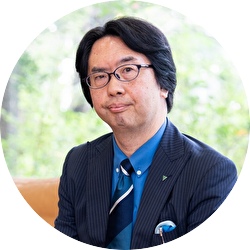
Seisa University Graduate School of Educational Practice
Professor Toshihiko Abe
Her areas of expertise are special needs education, educational counseling, and school counseling. For many years, she has been involved in providing consultation and support to children with developmental disabilities and their families. She also works to promote education that respects diversity, including the universal design of educational settings. Her publications include "Support that Values the Power to Ask for Help: Help Requests from Children, Parents, and Teachers" (Chuohoki Publishing), "Universal Design of the Human Environment: Classroom and Staff Room Edition" (Toyokan Publishing), and "Universal Design for Regular Classrooms: Plan ZERO-R" (Toyokan Publishing).