
Since its establishment in 2005, the Faculty of Culture and Information Studies at Doshisha University has been conducting unique research that uses data science to unravel culture, based on the principle of integrating humanities and sciences. Within this faculty, Professor Takayuki Iio is pursuing the nature of human-robot interaction. Professor Iio has demonstrated that "praise" from robots contributes to improving human skills, and that speaking ability improves through English conversation practice with robots. After clarifying the fundamental principles of human behavior in the laboratory, Professor Iio sends robots into the real world and designs the relationships between people and between people and robots that emerge there—Professor Iio's research stands at the intersection of engineering, psychology, and "culture."
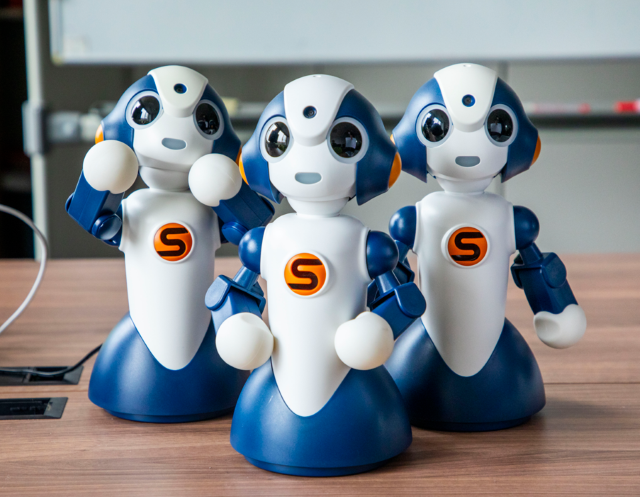
"Humans can adapt to robots"—the discovery that became the starting point of the research.
Professor Iio's path into robotics research began during his master's program when he happened to get an internship at a robotics research institute. During his internship, he was constantly engaged in painstaking programming to instruct robots to move, and was told that "it's all about getting it to move" rather than accuracy. "When I got involved in demonstration experiments, I understood what those words meant. If the robot initiated the interaction, most people reacted favorably to it." When the robots, which had been introduced to shopping malls, science museums, and elementary schools, spoke to people, many were not only surprised but also listened intently to their explanations.
There was an even more interesting discovery. While researching a robot that retrieves objects, the robot would confirm, "Is it that brown business card holder?" and gradually the user would begin to use color and size to give instructions. In other words, it was observed that humans also learn from others and consciously use a common language. "Humans may seem to think for themselves and be independent, but in reality, they are greatly influenced by others. This happens not only between humans, but with anything that behaves like a human. This discovery became the starting point for my research."
Interacting with robots fosters personal growth and brings out people's true feelings.
This realization that "humans are being pulled along by robots" became the core of subsequent research. Representative examples include studies showing that robots "praising" people leads to skill improvement, and experiments demonstrating that speaking ability improves through English conversation practice with robots.
In the English conversation experiment, subjects were divided into two groups for seven days: one group practiced with a robot for 30 minutes each day, and the other group had online English conversations with a human instructor. The results showed that the group that practiced with the robot showed greater improvement in both vocabulary and grammar error rates, as well as speaking fluency. "Practicing with a robot involves diligently repeating the same things over and over. That works as basic training and helps solidify the information in memory. On the other hand, human instructors are more service-oriented and incorporate casual conversation and application exercises. It's not a matter of one being superior to the other, but rather that they have different roles."
An interesting incident occurred during a dialogue experiment with elderly individuals. An elderly participant, speaking to a robot designed to continue conversations even with low voice recognition accuracy, tearfully recounted heavy memories of wartime experiences. A staff member at the facility observing the scene was surprised, saying, "I've never heard anything like that before." "The robot can sometimes elicit things that people wouldn't normally talk about. Perhaps the sense of security from not being judged is at play."
The "new roles" expected of robots
Through these experiments, Professor Iio envisions a society where robots do not replace humans, but rather a society where robots play the "just right" role, connecting people to one another.
"In today's world, where human relationships are becoming increasingly tenuous, I think it would be interesting to have robots in everyday environments, such as next to vending machines or in lounges, and for the robots to act as intermediaries between people who happen to be there." In this age where you can easily connect with anyone with just a smartphone, the professor believes there is meaning in chance encounters in physical environments. "I think that nowadays, especially for young people, the hurdle to interacting with strangers has risen. So, I'd like to dispatch robots to lounges where students gather. The robots would gather information through conversations with the students and act as coordinators, saying things like, 'That student over there is struggling with how to analyze experimental data. You're an analysis specialist, right?' Unlike smartphone notifications, it's a little awkward to ignore a robot that's physically in front of you. I'm aiming for an application where robots, which don't read the atmosphere, take the lead in things that humans tend to hesitate to do." Unlike matching on social media, the interesting thing about human society is when people who happen to be in the same place connect for just that moment and create innovation.
- 1
- 2

