Differences from robotics and psychology, and the unique characteristics of the Faculty of Cultural Information.
Even though both fields involve robots, Professor Iio's approach differs from that of so-called robotics. "Robotics often places emphasis on the precision of control and the beauty of the theory. In my case, even if the precision is a little rough, what's more important is whether people can use it easily and whether they want to interact with it."
Regarding the difference from psychology, he explains, "Psychology is a discipline that delves into the essence and modeling of human beings, but in my case, in addition to that, I also consider how to design technology so that people will want to use it. My research style deals with the entire cycle of design, understanding, field testing, and how to utilize it in the future."
Professor Iio says that this interdisciplinary approach is what makes the Faculty of Cultural Information unique. "I understand culture to be everything that is acquired through experience, not genetically. Technology and language are included in that. Robots are the same; they are not just technology, but entities that can create new culture in themselves. When artificial entities like robots enter the culture that has been shaped by human interaction, there is a possibility that the culture as it is now will change drastically. I want to witness that and design it."
To students who are curious about both technology and understanding people.
Professor Iio's laboratory conducts collaborative research with research institutions such as RIKEN (the Institute of Physical and Chemical Research) and ATR (Advanced Telecommunications Research Institute International). Students work on a wide range of themes, including research on the perspective of robots that walk alongside humans like walking partners, initiatives to connect communities using digital signage-linked robots that connect employees in corporate offices, and the changes in human empathy when interacting with robots that mimic human facial expressions. "You don't have to be interested in robots. If you are drawn to keywords such as using artificial objects to elicit human behavior, extending humanity, and making society better, then I think you are suited to this field."
Through robots, a new type of artificial construct, Professor Iio's research aims to deepen our understanding of humanity itself and enrich human relationships. This research exemplifies the unique learning opportunities offered by the Faculty of Cultural Information, where engineering skills and insightful humanities and social science perspectives are essential. Students acquire a foundation within a technological framework and then cultivate the ability to create new value. Professor Iio's pursuit of realizing a "world full of conscience" through robots will continue.
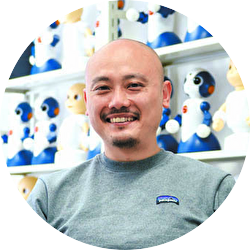
Doshisha University, Faculty of Cultural Information Studies, Social Robotics Laboratory
Associate Professor Takayuki Iio
He completed his doctoral studies in Information Engineering at the Graduate School of Engineering, Doshisha University in 2012, earning a PhD in Engineering. After working as a researcher at the Intelligent Robotics Laboratory of the Advanced Telecommunications Research Institute International (ATR), an assistant professor at the Graduate School of Engineering Science, Osaka University, and an assistant professor at the Faculty of Systems and Information Engineering, University of Tsukuba, he assumed his current position in 2021. He is participating as a principal co-researcher in the Cabinet Office's "Moonshot Research and Development Program" Goal 3, "By 2050, realize robots that learn and act independently and coexist with humans through the co-evolution of AI and robots."
- 1
- 2