
Studying at graduate school while working – what kind of future awaits? Tama University Graduate School of Management achieved a "100% overall satisfaction rate" in a survey of graduates in March 2026. Many students enroll after being introduced by graduates or current students. Why did they achieve a 100% overall satisfaction rate? What can one gain from studying at this graduate school, which is attended by many working professionals with practical experience? We visited Tama University Graduate School of Management, located a one-minute walk from Shinagawa Station, and spoke with Professor Ryuta Kono, the Dean of the Graduate School.
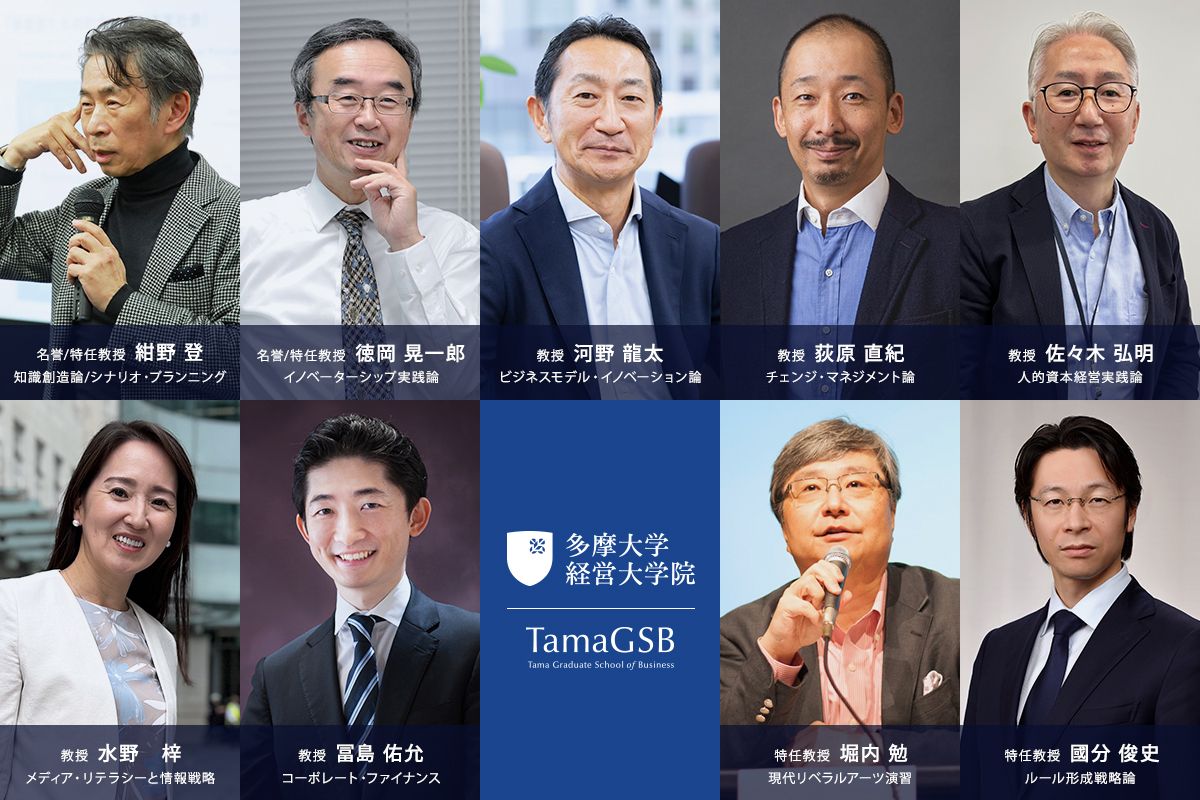
Learn practical management knowledge from leading practitioners.
Since establishing its master's program in 1993, Tama University Graduate School of Management has provided practical management education for working professionals. As of October 2026, it has produced over 1,200 graduates. Currently, working professionals from a wide range of industries continue to study while balancing their work and academic pursuits.
"Many of the people who attend our information sessions and those who actually enroll have extensive career experience. A high proportion are middle managers, senior managers, and executives, and we also have professionals in various fields," says Professor Kono, Dean of the Graduate School.
A survey conducted in March 2026 among graduates showed that overall satisfaction reached 100%. Many people learn about Tama University Graduate School of Management while gathering information about business school. On the other hand, many people enroll after being introduced by graduates or current students.
Many students choose Tama University's Graduate School of Management because of its faculty of practicing professionals actively working in their respective fields and its small class sizes.
"Many students cite two reasons for choosing our program: the opportunity to directly learn practical management knowledge from faculty members who are active practitioners in their respective fields, and the ability to study in depth in small classes," says Dean Kono.
Tama University Graduate School of Management, in addition to the management theories taught at typical business schools, adopts a unique concept called "Innovatorship" as its key concept. Defined as "leadership that continues to challenge itself to create innovation toward the 'desired future' based on passionate aspirations and practical knowledge," it offers a curriculum categorized into 14 fields.
The 14 fields include distinctive areas such as "Rule-Making Strategy," which involves creating rules for generating innovation in the world; "Healthcare Management," which involves learning about and considering solutions to challenges in medical care and nursing; and "Innovation Field," which focuses on themes such as entrepreneurship, new businesses, and intrapreneurship.
In the Innovation Field, students learn about knowledge creation theory, which forms the theoretical background of innovation, while considering entrepreneurship and the creation of new businesses within companies. A key feature is that students can learn about the realities of business creation from multiple perspectives, which cannot be fully grasped by theory alone, from practitioners with experience in startup support and new business development.
Furthermore, the school positions general knowledge as the "foundation for business planning," and offers a wide range of liberal arts courses to deepen understanding of history, philosophy, art, and other subjects.
While mastering management theory, students will absorb insights rooted in the experience of practitioners and apply them to their own work. In a small, intensive learning environment, they will hone their ability to view management from multiple perspectives and apply them to practical work.
The actual tuition fee is approximately 134 million yen. Many students continue their studies even after graduation.
Cost is another reason to choose Tama University Graduate School of Management. The tuition fee for two years is 262 million yen (for enrollment in April 2027). This is relatively low compared to other private university business schools.
Furthermore, the graduate school's master's program is a designated course of "specialized practical education and training" certified by the Minister of Health, Labour and Welfare. Therefore, if certain requirements are met, students can receive a grant of up to 128 million yen, making the actual out-of-pocket expense approximately 134 million yen.
Regarding the reasons why tuition fees can be kept low, Dean Kono cites the small class sizes run by faculty members with practical experience and the compact design of the facilities, which are focused solely on learning purposes.
"We have eliminated spaces that are not directly necessary for learning, such as lounges, large libraries, and faculty research labs, and operate with a compact design."
Furthermore, Tama University Graduate School of Management has a points system that allows graduates to continue their studies even after graduation. Points are awarded for participating in various activities, such as events organized by the graduate school, and graduates can use these points to enroll in courses.
Some students retake courses they didn't fully complete during their studies, while others take newly established courses after graduation.
Reference: [Tama University Graduate School of Management] MBA for Working Professionals: Choosing based on cost-effectiveness
https://tgs.tama.ac.jp/about/mba-cost-performance/?utm_source=chatgpt.com
An environment just a 1-minute walk from Shinagawa Station that makes it possible to "learn without quitting your job."
When studying at graduate school while working, accessibility is also an important factor.
The Tama University Graduate School of Management campus is located on the 5th floor of Shinagawa Intercity Front. It is conveniently located just a one-minute walk from the Konan Exit of Shinagawa Station, making it ideal for working professionals in central Tokyo.
"Shinagawa Station, which is served by various train lines, is extremely convenient, and some graduate students even commute by Shinkansen (bullet train)."
Lectures are held from 6:30 PM to 9:40 PM on weekdays and from 9:00 AM to 4:10 PM on weekends. This schedule is designed to allow students to attend weekday classes after work or to study using dedicated time on weekends. Furthermore, both in-person and online classes are available, allowing students to choose the learning method that best suits their work and lifestyle.
Tama University Graduate School of Management is making it possible to relearn management without changing your work style.

Turn work challenges into research topics. Create a "Life-Changing Action Plan."
Practitioner faculty, practical management knowledge directly applicable to results, small class sizes, tuition fees, and location. These are all factors that can be compared and considered before enrollment. However, the appeal of studying at Tama University Graduate School of Management goes beyond these. The learning that awaits you after enrollment is also a significant aspect. Among these, the doctoral dissertation is particularly important.
Tama University Graduate School of Management requires a thesis and a final examination as graduation requirements. The thesis can be either a "practical knowledge thesis" or a "master's thesis," with approximately 8% of graduate students choosing the practical knowledge thesis.
"Practical Knowledge papers focus on challenges that graduate students face in their own work environments. They delve into these challenges through management theory and research, develop solutions, and compile them into a paper. On the other hand, master's theses deepen research based on management theory. Regardless of which path you choose, you will receive the same degree."
Looking at the thesis topics, it's clear that graduate students are starting from issues they actually face in their own work and organizations, such as "Business succession problems in small and medium-sized enterprises," "Recommendations for transforming the R&D departments of large corporations into organizations that continuously produce results," and "Research on preparations for veteran employees to maintain 'lifelong active participation' in the latter half of their careers." Since many graduates connect the results of their research to their subsequent management and careers, Tama University Graduate School of Management refers to thesis papers as "action plans that change lives."
One graduate, who was in charge of new business development at a major education company and is currently an executive at a subsidiary, wrote a problem-solving thesis applying knowledge creation theory. After graduating, he used the results of this research to promote a new business, which has now become successful.
A graduate in her early 30s, who worked in human resources at a PR company, wrote a thesis on the disparity in children's experiences. She found that differences in family economic circumstances create disparities in opportunities for experiences such as travel, club activities, and tutoring. As she researched this problem, her desire to "solve the problem" grew stronger, and she quit her job. She returned to her hometown and established a non-profit organization.
Although they struggled with funding in the beginning, once their activities got on track, they began receiving offers of support from local companies.
It should be noted that formulating a research topic and translating it into a paper typically of around 20,000 words is by no means easy. Therefore, the graduate school has established a guidance system to support thesis writing. Graduate students belong to seminars led by faculty members whose research topics match their own, and under the guidance of their main and secondary examiners, they complete their papers over the course of a year through repeated dialogue.
"Many graduate students are initially intimidated by the idea of writing a thesis. However, once they start their research, they encounter obstacles and go through trial and error, but they begin to find the research fascinating. Before they know it, they're so engrossed that they wish they had more time."
Learn together for two years with colleagues you wouldn't meet at work.
Another attractive aspect of studying at this graduate school is the "peers" you'll build.
Spending two years in a small class while juggling work, you learn in the same classroom on weekday evenings and weekends, and see each other in various courses. Working on assignments together and engaging in discussions, you come to know each other deeply, even with people you wouldn't have met through work alone.
The student body is diverse in age, with about 3% being international students. Interacting with people from different generations and industries exposes you to different perspectives. Younger, less experienced individuals have an open mind free from preconceived notions. More experienced generations possess knowledge cultivated through years of work. The very act of discussing with peers from diverse backgrounds is a learning experience.
Some students enroll with a clear purpose, while others knock on the door because they feel anxious about their future careers and think, "I can't grow if I stay like this." And in both types of students, a certain percentage change during their two years of study. They develop an interest in an area they never considered when they enrolled, and eventually write a thesis on that topic.
"They are likely gaining new insights through discussions with faculty members and conversations with their peers," says Dean Kono.
The key phrase promoted by Tama University Graduate School of Management is "re-arming with knowledge."
Learn practical knowledge from leading practitioners, research your company's management challenges, and present your findings in the form of a thesis. Engage in discussions with peers from diverse generations and industries, and apply the insights gained to your work and new challenges after graduation.
The 100% overall satisfaction rate among graduates is a testament to the learning that takes place over these two years. Each graduate student confronts their own personal questions, opening up a path to an unknown career.
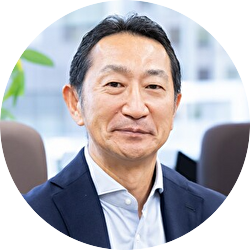
Dean and Professor, Graduate School of Management, Tama University (Graduate School of Management Information Science, Tama University)
Ryuta Kono
He graduated from the Faculty of Law at Waseda University and obtained an MBA from the Warwick Business School at the University of Warwick, UK. After working at Hakuhodo and Hakuhodo Brand Consulting, he held executive positions at several IT venture companies. Subsequently, he founded InsightLink Co., Ltd., where he provides support for strategy formulation, new business development, new product development, and human resource development training in a variety of industries. He also has extensive experience in executive coaching, primarily for executives and managers of major corporations. He is a certified trainer of Strategyzer, founded by Alex Osterwalder, a world-renowned management thinker and developer of the "Business Model Canvas."

