
Support systems for students vary from university to university. Wayo Women's University provides student support by incorporating AI and learning support apps, and offers education that is tailored to each student's dreams and goals. We spoke with Professor Masaki Taga, Professor of Health and Nutrition in the Faculty of Home Economics and Head of the Academic Affairs Department, about the content and aims of this support.
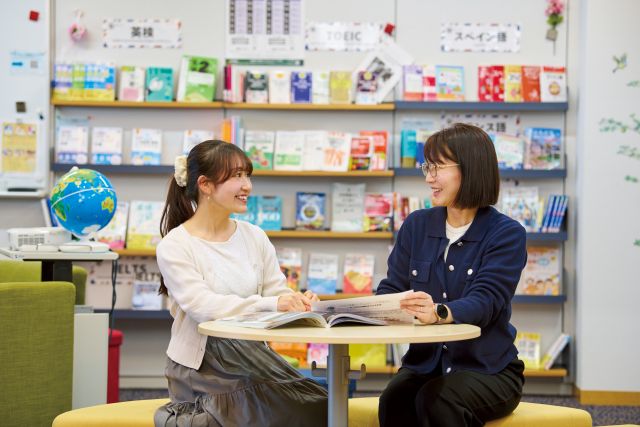
Detailed support from the time of enrollment to foster proactive learning at university.
University lectures are vastly different from those in middle and high school. In middle and high school, you go to a designated classroom, the teacher comes and teaches when it's time, and then you move on to the next class. There may be exceptions such as proficiency-based classes or elective courses, but basically, everyone in the same class attends the same classes in a designated classroom. In university, you choose the lectures you want to take and create your own timetable. You go to the designated classroom at the time of the lecture and attend the lecture. Because this is different from the style you've been used to in middle and high school, it's easy for people to get confused and make mistakes in course registration (such as not selecting a required course or exceeding the course limit). University campuses are often large, so getting lost is also a possibility. Moreover, right after enrollment, you're surrounded by strangers and don't have any friends.
"At Wayo Women's University, in addition to guidance sessions on qualifications and other matters organized by the Academic Affairs Office, we have a homeroom teacher system in place, allowing students to consult with the same teacher on various matters for all four years. Furthermore, there is a faculty advisor assigned to approximately every eight students, who provides advice on course selection, such as which subjects to take, and addresses any concerns students may have after enrollment."
Having advisors who know each other by face and are willing to offer detailed advice will likely be a great source of support for students. After the entrance ceremony, students meet with advisors within a few days, and then have individual consultations about twice a year, where they can discuss not only course registration but also academic performance and daily life. In April, when many first-year students are feeling anxious, staff from the academic affairs department also patrol the campus wearing pink jackets to assist students in need.
In addition, in the mandatory introductory seminars, students will learn how to write reports, create presentation materials, give presentations, and set goals for their future studies, as well as the history of the university, thereby acquiring the fundamental skills necessary for university-level learning.
Even regular lectures have classes of 20 to 30 students, and both students and faculty seem to feel a close relationship. Students can easily consult with faculty, as they can ask questions during and after lectures, as well as through the learning management system.
Visualize your learning and growth over four years with our unique portfolio, "WayoJam".
Starting in the 2023 academic year, Wayo Women's University began full-scale operation of its unique student portfolio system, "WayoJam." In addition to academic achievements such as the results of regular tests and reports, students can also register their personal goals and records of extracurricular activities. This allows them to visualize, using radar charts and graphs, how well they are meeting the diploma policies (graduation certification and degree awarding policies) set by each department, and what areas they need to acquire in the future. Students can use this system to plan their studies for the following year, as well as for self-discovery and job hunting.
"This allows students to realize what they have learned and how they have grown at university, and it also provides faculty members with an opportunity to reflect on the results of their education. Furthermore, by sharing these results among faculty members and using them to improve classes and the curriculum, we aim to provide education that supports students' growth throughout their four years at university."
While utilizing AI, we also aim to cultivate independent thinking skills and interpersonal abilities.
Learning about AI, which has been rapidly permeating our lives in recent years, is one of the things expected of university students. From the 2028 academic year, all faculties will be required to complete the "Mathematical Science, Data Science, and AI Education Program Accreditation System (MDASH)" literacy level* promoted by the Ministry of Education, Culture, Sports, Science and Technology, so that students can use AI to a certain extent. Currently, AI is already being used in many lectures. However, Professor Taga warns that relying too much on AI is not good.
"In the Department of Health and Nutrition, which I oversee, if we had an assignment to create a 1600kcal daily meal recipe for a diabetic patient, AI could do it in seconds. But as a registered dietitian, when actually cooking, I have to consider the patient's likes and dislikes, allergies, cooking time, and saltiness. In order to be as attentive to the patient as possible, we can't leave everything to AI. It's said that the spread of AI will reduce opportunities for people to think for themselves. I want to cultivate not only AI knowledge but also the ability to think for oneself and develop human qualities."
In supporting students, we prioritize providing attentive and personalized assistance from the very beginning of their studies. As students progress through their second and third years, we observe them as they learn to think and act independently, and offer support whenever they need it. We value adapting our support methods to each student's growth. "How you grow at university is a key phrase at Wayo University. We, the faculty and staff, are committed to supporting you as a university where you can grow, and we have a comprehensive support system in place. For those who have dreams and goals, we encourage them towards achieving them, and for those who haven't yet found theirs, we support them in their search. We value how students grow and how they can add value as university students by developing their own unique strengths and individuality."
In terms of adding value, students can also utilize their hobbies and special skills. If you enjoy drawing, you can draw the day's menu to stimulate the appetite of those who eat it; if you like the outdoors, you can contribute your skills in disaster relief cooking. Wayo Women's University also engages in industry-academia collaboration with various companies, creating an environment where each student can challenge themselves with new possibilities.
*Mathematics, Data Science, and AI Education Program Accreditation System (MDASH)
The literacy level is a certification system launched by the Ministry of Education, Culture, Sports, Science and Technology in 2021, aiming to acquire introductory-level mathematics, data science, and AI as fundamental skills for the digital society. At Wayo Women's University, this level can be achieved by completing designated courses from the 2028 academic year onward.
https://www.mext.go.jp/a_menu/koutou/suuri_datascience_ai/00001.htm#01
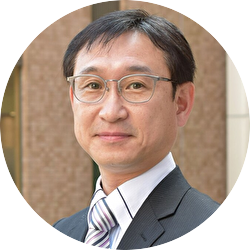
Head of Academic Affairs, Department of Health and Nutrition, Faculty of Home Economics, Wayo Women's University
Professor Masaki Taga

