At Toyo Eiwa University's Graduate School, a co-educational graduate school for working professionals, people of all ages are studying for a variety of purposes, including reskilling and career advancement. One such person is Maho Tamura, a first-year master's student in the Early Childhood Education and Developmental Clinical Studies area of the Department of Human Sciences, Graduate School of Human Sciences. We interviewed her about her reasons for deciding to enroll in graduate school, her daily studies, and her future prospects.
I want to study childcare again. My interest in graduate school became apparent while working.
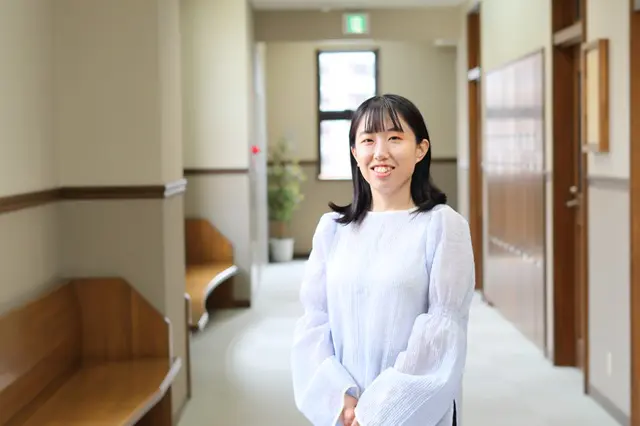
Ms. Tamura is a graduate of the Department of Childcare and Early Childhood Education (now the Department of Child Education) at Toyo Eiwa University. She is currently working as a kindergarten teacher in Yokohama City. As she entered her sixth year as a working professional, she enrolled in the graduate school at Toyo Eiwa University.
"For the first few years after starting work, I was completely overwhelmed with my job, but gradually I had more opportunities to think about and practice childcare on my own. I started to have questions, such as how to expand play with children. Also, having the opportunity to go on a short-term training program overseas made me want to learn about Japanese childcare again. It was because I was out in the field and interacting with children that my interest in graduate school grew stronger."
The influence of her advisor, Professor Nishiko, was also significant. Even during her undergraduate years, Professor Nishiko had suggested that she consider graduate school as an option. Furthermore, after graduating, her participation in Professor Nishiko's workshops made the path to graduate school seem more realistic to her.
"At the workshop, I had the opportunity to meet graduate students. In particular, when I spoke with them last year, I realized that I might want to attend graduate school myself—it was an interest I'd had in my heart."
My desire to study under Professor Nishi led me to choose Toyo Eiwa University Graduate School. Furthermore, Toyo Eiwa University's approach to early childhood education, which I had experienced since my undergraduate days, was also a deciding factor in my choice.
"At our university, we value observing and considering each child's development, individuality, and circumstances based on the Christian principle of 'reverence for God and service,' and we believe that this also allows caregivers to develop a richer sensibility. The kindergarten where I currently work is also Christian-based, and I have always valued loving each child individually and being attentive to their interests and concerns. The opportunity to relearn these aspects is one of the reasons I chose to attend Toyo Eiwa University Graduate School."
The "norms" of early childhood education have changed. A broadening of perspective felt through the lessons.
The students studying in the field of early childhood education and developmental clinical medicine are not only active kindergarten teachers like Ms. Tamura. They come from a wide range of professions and age groups, and diverse opinions are exchanged in the classes.
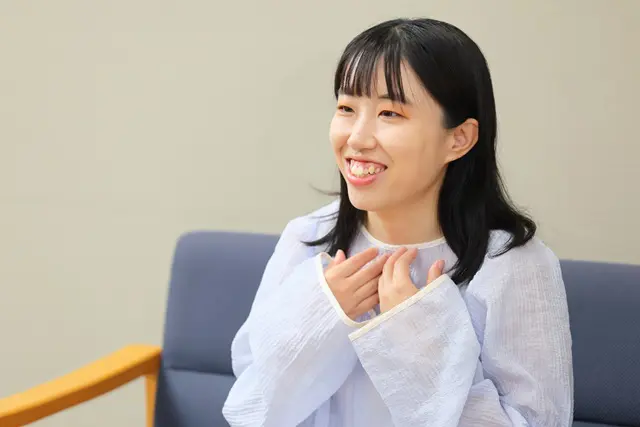
"I realized that things I took for granted weren't necessarily so, and it broadened my perspective. After working here for five years, there were things like how to talk to and interact with children that I had started to take for granted. But listening to everyone's opinions, I learned that there are completely different ways of thinking in other workplaces. It's really fun to gain new perspectives and think about things from a fresh viewpoint."
One of the episodes that Ms. Tamura mentioned as particularly memorable was a discussion in a class called "Advanced Topics in Childcare Content" about whether or not to rank the children at a sports day.
"At the nursery where I work, our goal is for everyone to work together and pass the baton to the end. That's why we don't rank the children. However, some people have suggested that it might be good for the children to have an opportunity to learn that they will be ranked in the real world. I realized that both viewpoints have valid reasons, and there is no superiority or inferiority. I think it's important for adults involved in childcare to discuss these kinds of issues, not just in this case."
In addition, in "Advanced Topics in Information Education," she is learning about childcare and ICT. Although ICT was unfamiliar to her at work, she says her perception has changed after learning about practical examples in nurseries and kindergartens during the class.
"Before taking the class, I didn't have a very good image of ICT. But at that kindergarten, they were creating and playing sounds for plays using tablets. When creating the sounds, the children were discussing with each other how to make the sounds they envisioned. I realized that ICT could also be used as a tool in childcare, and my negative image changed."
The importance of learning through practice. Consider graduate school for working professionals as one of your options.
Ms. Tamura is currently working as a kindergarten teacher while attending graduate school. Balancing work and studies is challenging, but she is also realizing the appeal of learning while working.
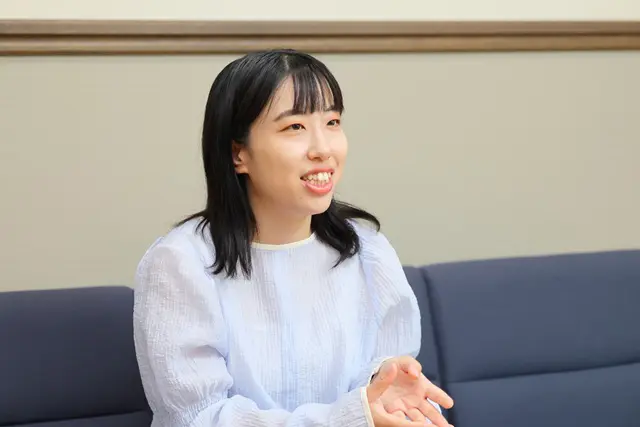
"Because I can learn while visualizing practical applications, the content is easier to grasp. Even things I learned in undergraduate school, I was able to recall parts I had forgotten and notice important points. I want to continue learning while working, as someone who is closest to children."
Toyo Eiwa University Graduate School offers classes on weekday evenings and Saturdays. Online classes are also available in some cases. This environment also supports students in balancing their studies with their work.
"Classes start at 18:30 PM on weekdays, so I can make it if I leave right after finishing work. I usually find time to study after classes on Saturdays or on Sundays."
Ms. Tamura plans to continue working at a kindergarten after completing her master's degree. She hopes that her studies and research in graduate school will have a positive impact on how she interacts with children.
"For the past five years, I've been sharing what I've learned through dialogue with children. But I've realized there's so much I don't know, so I want to take in more information. I want to have a wider range of perspectives and options when I interact with children."
Before enrolling, Ms. Tamura had anxieties about balancing work and graduate school, but now she feels that enrolling was the right decision. Finally, we asked her for a message to those considering enrolling in graduate school.
"There are many choices in life, such as changing jobs or getting married. I thought it would be great if graduate school for working adults became more widespread as one of those choices. The childcare industry, in particular, is full of challenges, and there may be times when you don't have the time or energy. But in graduate school, you can take a step back and reflect on your own childcare practices. It feels less like relearning and more like making new discoveries. Moreover, since graduate school is a two-year program, you can retain the content better than in a short-term internship, and deepen your understanding of childcare through practical experience. If you have the desire to learn, please consider going to graduate school. I would be happy if Toyo Eiwa University Graduate School is one of the options you consider."

Toyo Eiwa University Graduate School of Human Sciences, Department of Human Sciences, Early Childhood Education and Developmental Clinical Studies, 1st year Master's student
Maho Tamura
She graduated from the Department of Childcare and Education (now the Department of Child Education) at Toyo Eiwa University. She works at a kindergarten in Yokohama City and enrolled in the graduate school of Toyo Eiwa University in April 2026.