International politics may seem like something that only happens in distant countries. However, we now live in an era where even our own local communities are no longer unrelated to overseas affairs. Take childcare, for example. Natsuko Mugishima, a second-year master's student at Toyo Eiwa University's co-educational graduate school for working adults, is conducting research that combines diverse perspectives, including childcare, digital transformation (DX), and France. We interviewed Ms. Mugishima about the characteristics of the International Politics, Economics and Regional Studies course in the International Cooperation program of the Graduate School of International Cooperation, to which she belongs, and her reasons for continuing to study while working.

International politics, software engineering, parenting... all my experiences led me to graduate school.
During her student years, Ms. Mugishima studied international politics and also studied abroad in France. After graduating, she worked as a systems engineer (SE), but changed careers to become a childcare worker after giving birth.
"I like efficiency, and I felt there was no point in continuing to work in a field that didn't have any synergy with my personal life. Even if I continued as a systems engineer while raising children, my working hours would inevitably be less than someone who was solely a systems engineer. I hated the idea of being treated as a burden on society despite investing as much time as I could. I wanted a job where childcare wouldn't be a negative factor, so I obtained a national qualification and switched careers to become a childcare worker."
Afterward, Ms. Mugishima leveraged her experience as a systems engineer to begin working on DX (digital transformation) to support improvements in the working environment for childcare workers. Through her interactions with various childcare facilities, she noticed a particular issue.
"At the childcare center, we're seeing an increase in children with foreign roots, and even if we improve work efficiency, I've noticed that the childcare workers don't feel they have enough time to spare. This isn't the fault of the children or the childcare workers. One of the reasons is that there's simply no way of thinking to adapt to the changing times. I was able to realize this perspective thanks to a conversation with Professor Yasuyuki Kokubo, who I was indebted to during my university days. He suggested that by studying France, a country with a large immigrant population, I might be able to find clues to how to accept children with foreign roots in Japan. I was surprised that my work could be connected to international politics."
Professor Kokubo is a visiting professor at the Graduate School of International Cooperation Studies, Toyo Eiwa University. Ms. Mugishima decided to enroll in graduate school because she wanted to study under Professor Kokubo. She is preparing to write her master's thesis on the theme of "Policies for accepting preschool children with foreign roots," researching the case of France. Some of her classmates work in the education field, and their firsthand experience interacting with children with foreign roots has also been invaluable to Ms. Mugishima.
"It's refreshing that the participants aren't limited to those specializing in international relations or similar fields. It's great to learn about the circumstances of people in other industries, which we don't usually get to hear about. This is something unique to Toyo Eiwa University Graduate School, which opens its doors to a wide range of people."
Furthermore, my interest in the Graduate School of Human Sciences at the same university also encouraged me to enroll.
"I obtained my childcare worker qualification through a national examination, so I never attended a training school. I think the opportunity to systematically study childcare is what makes Toyo Eiwa University Graduate School so appealing. I was actually able to take the 'Advanced Topics in Childcare Content' course in the Graduate School of Human Sciences. I feel like the experiences in my life that seemed disparate have all connected in graduate school."
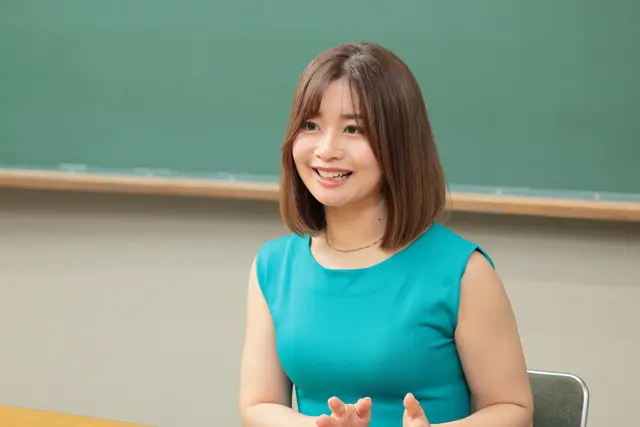
The opportunity to challenge yourself with things you don't understand is what makes graduate school so appealing.
What Ms. Mugishima finds interesting about graduate school classes is the opportunity to tackle unfamiliar topics. She said she was particularly inspired by Professor Kyoko Tanaka's "Advanced Topics in International Law" course.
"It was extremely difficult and presented a great challenge academically. I had to tackle something I didn't understand at all, starting from scratch while reading high-level books. Professor Tanaka would ask me to re-examine each point, 'What does this mean?', and I was shocked to realize that I had unconsciously thought I understood things."
In my regular job, I rarely get the chance to do things I don't know or am not good at. It's more efficient to leave it to someone else. I think graduate school offers opportunities that are often discarded in society due to the elimination of waste."
Although I studied international law once during my undergraduate years, I'm approaching it from a different perspective in graduate school.
"I used to think that international law was a field of study where you learned the content, setting aside whether or not it was effective. However, the book we used in Professor Tanaka's class was written with the premise of exploring the significance of international law that is not effective. It seriously confronts the questions of why international law exists and whether it would be alright without it. That perspective stimulated me, as I had fallen into a state of intellectual stagnation, thinking, 'That's just how international law is.'"
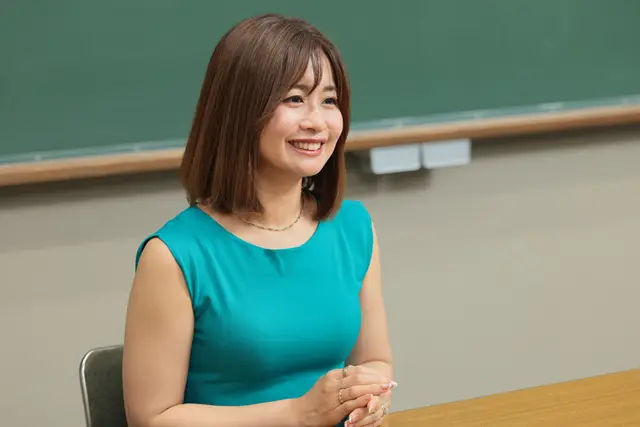
I was helped by the extension system and online classes. Balancing work and studies.
Ms. Mugishima runs a company she started just a few years ago, and is attending graduate school while raising children. While a typical master's program is two years long, she was able to extend her studies to four years by utilizing the extended enrollment system.
"If you complete your master's program in four years, you can significantly reduce the number of courses you have to take each semester. Furthermore, thanks to the support of my family, I can balance work and studies without negatively impacting childcare, which I'm very grateful for. However, I initially thought I had to complete it in two years, so I was surprised when I learned about the extended study program upon enrollment."
Other factors that help students balance work and studies include hybrid classes for all subjects, allowing them to participate both online and in person, and a convenient location. Ms. Mugishima felt that this environment, which allows people to study while working, would be a great encouragement to many working adults.
"Of course, quitting your job to study is one option. However, many people don't know if graduate school is worth the halt in their careers. Also, I don't think there are many people who can survive without working for two years. That's why an environment where you can study while continuing to work is attractive. I think you can become a person with deep knowledge while reducing the risks to your career and life."
Ms. Mugishima has gained a wealth of knowledge in graduate school, including international politics and early childhood education, which she uses to generate ideas for her work. She is also eager to continue applying what she has learned to her career after graduation.
"First, in my master's thesis, I want to develop solutions for improving the system surrounding childcare centers in Japan. However, the next challenge is how to adapt those ideas to society. After graduation, I want to dedicate myself to activities that pave the way for their realization. I want to create a society where children from diverse backgrounds, both domestic and international, can be accepted without relying solely on the efforts of individual childcare workers or centers, and where the working environment for childcare workers is not negatively impacted. I want to realize such a rich childcare environment and a society where people can raise their children with peace of mind."
Toyo Eiwa University Graduate School accepts diverse working professionals regardless of their undergraduate major or current occupation. That's why Ms. Mugishima felt it was important to attract a wide range of people to the program.
"The professors at Toyo Eiwa University Graduate School value what you want to research in the future more than what you've done in the past. That's why there are many people in the Graduate School of International Cooperation who have never studied political science or sociology. All the professors are dedicated to helping each student learn in depth, so I highly recommend it as a place for working adults to study."
Natsuko Mugishima
President and CEO of Hosukerin Co., Ltd. She works as a business consultant promoting DX (Digital Transformation) in the childcare industry. In April 2025, she enrolled in the International Politics, Economics and Regional Studies course at the Graduate School of International Cooperation Studies, Toyo Eiwa University.