Have you ever realized you have a hidden desire to learn, such as "I want to learn a new field" or "I want to acquire skills that will be useful in my work"? Toyo Eiwa University Graduate School, a co-educational graduate school for working professionals, is where such people gather. What are the daily lives of working professionals actually studying in the master's program? Let's take a look at the experiences of Nobuyuki Asai, a first-year master's student in the International Politics, Economics and Regional Studies course of the International Cooperation Program in the Graduate School of International Cooperation Studies.
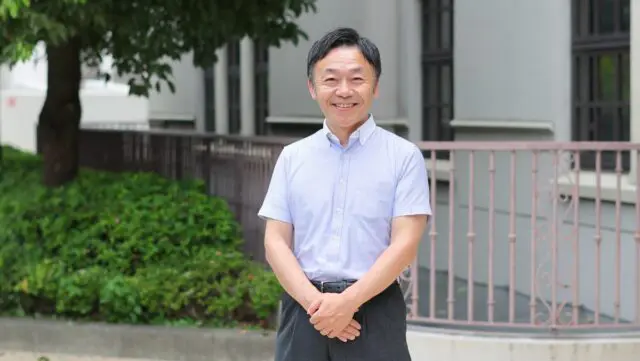
I considered this my last chance to put my graduate studies to use in my work.
Ms. Asai currently works for a religious NGO. She has opportunities to prepare policy recommendations and work with overseas organizations to address issues. It was about 10 years after she started working for the NGO that Ms. Asai began to consider graduate school.
"I've been working at my current job for 15-16 years, but after about 10 years, I started to want to know about the latest trends in international cooperation. I also felt the need to objectively view our own activities and clarify their positioning and challenges. I thought that if I went to graduate school, I could meet people in similar professions or related fields, so I started to consider enrolling."
Furthermore, policy recommendations require evidence. I became interested in graduate school because I believed that acquiring the academic methods necessary for this would further improve the quality of my work."
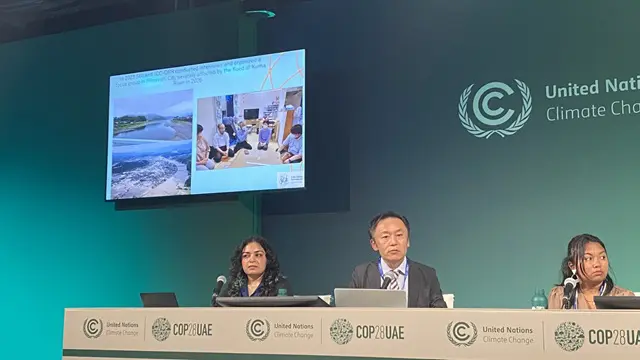 Participating as an NGO in the Conference of the Parties to the United Nations Framework Convention on Climate Change
Although I had envisioned going to graduate school, it took me several years to actually take action. That's because I wanted to prioritize my personal life, including raising my children.
"A few years ago, my children were still in the lower grades of elementary school, so I prioritized spending time at home helping them with their homework and playing with them. Now that my children have grown up a bit and I have more free time, I looked into graduate school again about a year ago. If I waited any longer, it would be difficult to apply what I learned to my work. I decided to enroll because I felt this was my last chance to learn as a working adult. My wife also supported my decision."
The deciding factors in choosing Toyo Eiwa University Graduate School were the existence of the International Cooperation Studies program, which is highly compatible with my work, the fact that I could receive a government grant for specialized practical education and training which would reduce tuition fees, and the fact that there were faculty members I already knew.
"I already knew Visiting Professor Saburo Takizawa, so I asked him for advice regarding graduate school. When I told him about a topic I wanted to write about for my master's thesis, he said, 'It's a topic that hasn't been covered before, so I'd really like you to try it.'"
The appeal of graduate school classes: exposure to diverse backgrounds.
Upon enrolling, I found that the students came from far more diverse backgrounds than I had anticipated. The classrooms were filled with people working in various fields, including the Ministry of Foreign Affairs, JICA, development consulting firms, and educational institutions. There were also those aspiring to work in international cooperation, as well as former members of the Japan Overseas Cooperation Volunteers.
"Initially, the focus was on lectures by the professors, but gradually, opportunities for students to present have increased. Because everyone uses their individual backgrounds in their presentations, I gain many valuable insights."
In the "Advanced Topics in International Law" class, Ms. Asai also had the experience of giving a presentation. She was assigned a chapter from the textbook, critically analyzing its content and stating her points. She said there were times when she had to objectively re-examine her own experiences and add her own opinions.
"International law has traditionally been thought of as merely a matter of treaties and agreements between governments. However, this semester's textbook points out that a system is needed that involves actors other than states. My colleagues and I, having experienced such situations as NGOs, presented our findings, suggesting that our past activities may have contributed to the formation, maintenance, and development of international law."
Asai finds enjoyment in being exposed to diverse perspectives through the presentations.
"Instead of simply sharing anecdotes, the instructors share their experiences and challenges while connecting them to the class theme. Since the class size is often limited to around 10 students, the instructors are familiar with each student's background and prompt them to speak at the appropriate times."
She finds it appealing that she can take courses not only in her own International Politics, Economics, and Regional Studies course, but also in other courses and graduate schools. She is particularly interested in the Thanatology course offered by the Graduate School of Human Sciences.
"I already knew that this university offered courses in thanatology, and I was interested because it has strong ties to religion. I found out after enrolling that it was possible to earn credits, so I would like to take courses in the future. There are also people from the education-related fields of the Graduate School of Human Sciences who participate in the courses of the Graduate School of International Cooperation, and we have broadened each other's perspectives."
One of the things that helps me balance work and studies is the ability to participate in classes online. Toyo Eiwa University Graduate School is implementing hybrid classes for all courses. Students can take classes either in person or online. They choose the method of participation that suits their location and work schedule.
"I try to attend classes in person as much as possible, but when work prevents me from coming, I participate online. Some students live in Osaka, and others participate from Africa. Even online, they can participate in discussions on equal footing with students attending in person."
Ms. Asai is currently considering a topic for her master's thesis in consultation with her supervising professor, Dean Takeshi Kono. Although it hasn't been officially decided yet, she plans to delve into a topic that is closely related to her work.
"Religious NGOs don't receive much attention in Japan, but there are many of them around the world. Their unique roles and challenges have been discussed in various forms. For my master's thesis, I'm currently thinking of researching the efforts and challenges of religious NGOs, particularly regarding climate change."
"Social Science Research Methods," which teaches how to write academic papers and how to research literature, is also one of Asai's favorite classes.
"It was a world I hadn't really encountered before, so I felt it was very important content. I think it will be helpful as I engage in policy advocacy activities in the future. It will make it easier to think about what perspectives are necessary and what I need to investigate further. Also, I now have more people I can ask questions to. I'm sure that expanding my network will be useful in the future."
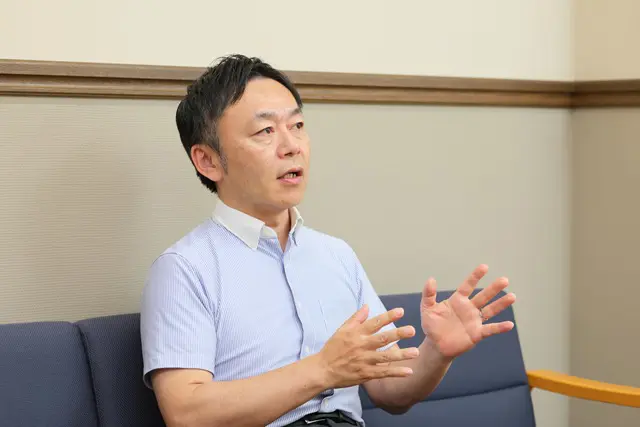
Learning with a sense of purpose. The significance of working adults attending graduate school.
"I have many regrets when I look back on my undergraduate days," Asai says. She began attending graduate school after becoming a working adult, and felt that her approach to learning had changed.
"During my undergraduate years, I think I chose classes that seemed interesting or easy to get credits in. My attitude and understanding were insufficient, which was a waste. Now I can approach classes with a sense of purpose, and I also have experience and knowledge gained from my work. I've gained a broader perspective on society and academia, and I now have a better understanding of where what I'm currently studying fits in."
Asai hopes to improve the quality of her work by utilizing what she learned in graduate school. She also hopes that she will be able to participate in discussions with the overseas organizations with which she collaborates from a more specialized perspective.
"Some of the overseas organizations I collaborate with have individuals with doctoral degrees, but my workplace doesn't have anyone like that. I hope to participate more in specialized discussions that I haven't been able to fully understand until now, and improve the quality of our activities. Also, in today's world, conflict and division are becoming more serious, and leaving it solely to national leaders and political leaders may not lead to a good outcome. There will be an increasing need for civil society and well-meaning people to work together more closely to address these issues. I would like to contribute in some small way to such situations."
Finally, Asai delivered a message to working professionals who are interested in graduate school.
"For those who question the state of global issues and think, 'Is this really okay?', this is a very stimulating environment. Graduate school may have a rigid image, but the professors are very approachable. Even regular classes feel like discussions in a cafe, and high-quality opinions emerge from that. Why not consider graduate school a little more casually?"
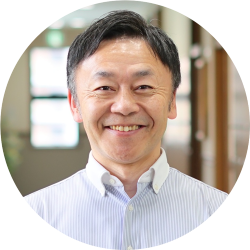
Toyo Eiwa University Graduate School of International Cooperation Studies, International Cooperation Program
International Political Economy and Regional Studies Course, Master's 1st Year
Nobuyuki Asai
She works for a religious NGO, involved in activities aimed at solving international issues such as sustainable development and humanitarian problems. In April 2026, she enrolled in the International Politics, Economics and Regional Studies course of the Graduate School of International Cooperation Studies at Toyo Eiwa University.